
Walking amid a group of families last weekend, gathered on the morning of July 4th to celebrate in patriotic song, reading aloud of our country’s founding documents, and an impromptu mini-parade, I was reminded of Alexis de Tocqueville’s observation:
Local assemblies of citizens constitute the strength of free nations.
Tocqueville was touring America in the early 1830s, around 50 years after the end of the Revolutionary War, seeking to understand how and why this new way of constituting a nation worked.
It was, and we are, quite odd.
This hadn’t quite happened before in the history of the world – Sure, there had been revolutions before, and even various forms of democracy. But the American Revolution differed from all of those in that it was premised on the objective laws of our human nature and their Author, and the belief that governments derive their legitimate powers only from the consent of the governed. This premise, coupled with an idea that we could govern ourselves, had never before been attempted in the history of the world.
We accept it today as a given template, but it was an altogether new entry in the annals of history.
Which also leads to another interesting observation: although America is not among the oldest countries on the earth, we are the oldest continuous constitutional democracy. At 250 years of age now, we are the oldest in recorded history. That’s something worth a pause.
But I’m reminded, too, of Benjamin Franklin’s famous line as he exited Independence Hall when the Framers had finally reached agreement on the U.S. Constitution in 1787:
‘You’ve got a republic, if you can keep it.’
And it’s true, democracy, freedom are far from foregone conclusions; they are not guaranteed. The truth that the human person is meant to be free may be inalienable, but it is not at all times and in every place observed. It comes about, is maintained and preserved, and it is advanced, only when it is seen as a treasure worth sacrificing for.
Perhaps this is no more illustrated than in our country’s own civil war, and the immortalized words of Abraham Lincoln in the hallowed grounds at Gettysburg where, following two dark years of war, it finally began to be possible to hope that our nation might actually continue: whether ‘a government of the people, by the people, and for the people would perish from the earth’, or not.
He helps us to remember: none of this is inevitable. He stood there in 1863, 87 years from our country’s founding. Another man would stand in front of his statue 100 years later to ‘cash the check’ that had been written in the promises of our founding documents. To fully recognize that, indeed, all are created equal. Dr. Martin Luther King, and those who would stand with him, would insist that their country honor its pledge, and remain true to its essence.
From these, and other developments in our nation’s history, we see that freedom is not a static thing, it is an arrow moving through time, and can grow and shrink, twist and turn. History is not just something that happened; it is something that is happening. And from that reality we can see, that the arrow of freedom has another side: its other side is responsibility. The two are inseparable.
And so I return to Tocqueville’s observation: ‘Local assemblies of citizens constitute the strength of free nations.' This 250th is an opportunity to reflect on the treasure that has been handed onto us, entrusted to us. All hands that have held this treasure are imperfect, but their nobility, like ours, is in the striving to make it more perfect, in seeking, ‘with a firm reliance on the protection of divine Providence’, to make a ‘more perfect union’ among ‘ourselves and for our posterity’.
Happy 250th! 🙂
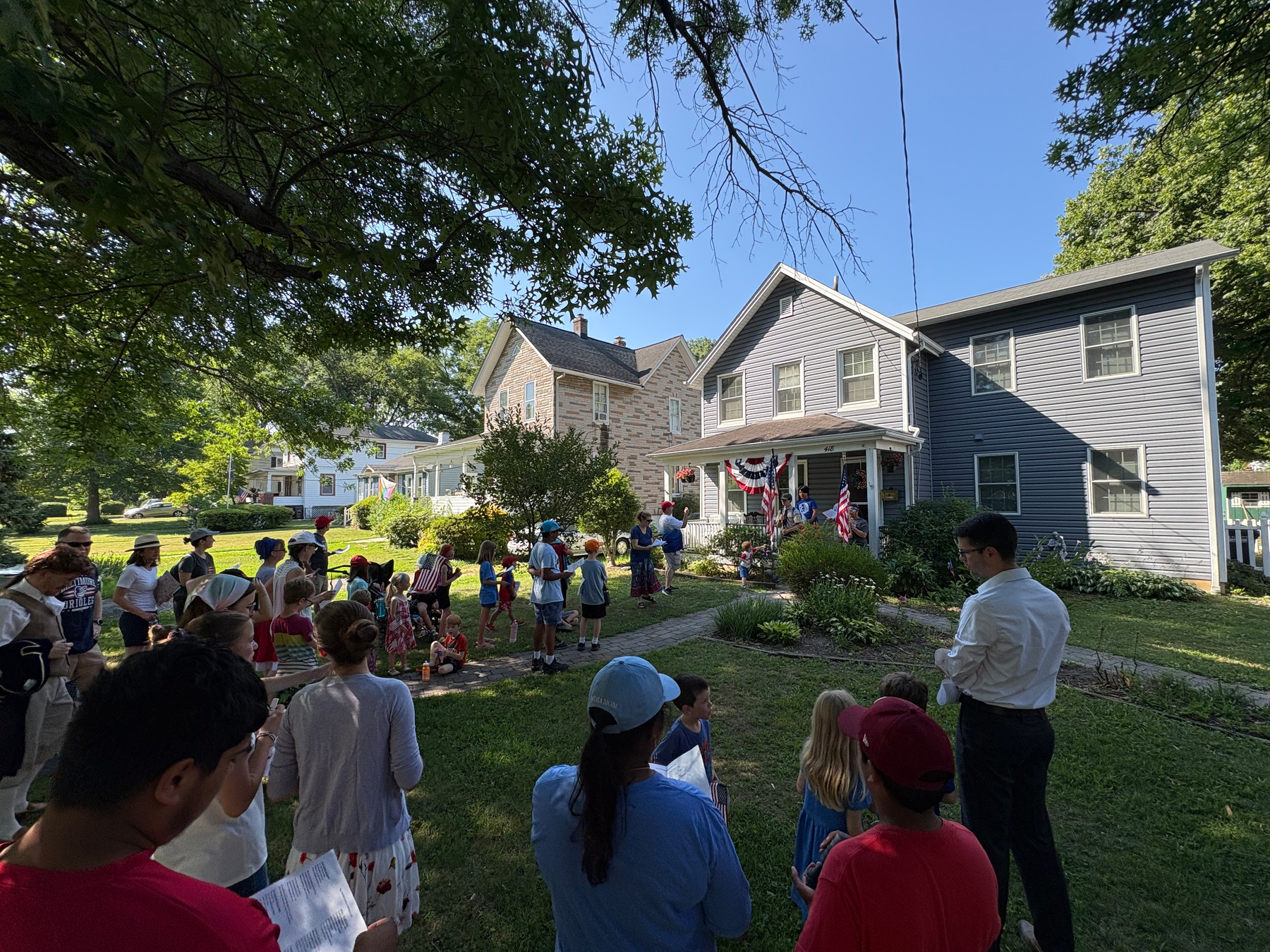
(Families gathered for impromptu 250th celebration.)
(Laurel’s 250th fireworks at Gude Park.)